Standing Water Removal for Summerfield Homes
In a town of private wells and septic tanks, standing water usually comes from inside the house itself. Extraction pulls it off floors and carpet before it climbs the walls and soaks the subfloor.
(888) 578-4720Call for water removal in Summerfield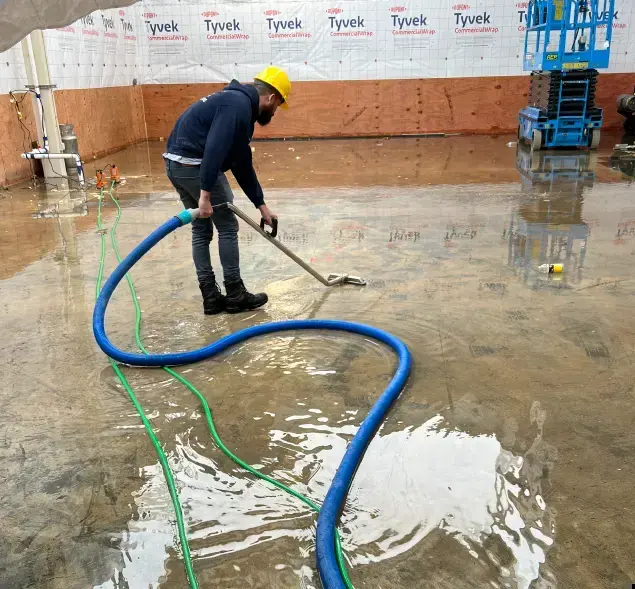
First steps for water extraction and removal in Summerfield
- 01
Stop the supply
Close the fixture valve or main shutoff before moving anything else.
- 02
Cut the power
Turn off breakers to wet rooms and keep out of standing water near outlets.
- 03
Lift valuables
Move rugs, electronics and small furniture onto dry surfaces, and photograph the water first.
- 04
Request extraction
Describe the water source and how many rooms are wet so the right pumps and drying gear are sent.
How water extraction and removal is handled in Summerfield
Extraction is the first real step after a leak, and it decides how much of the house stays dry. In Summerfield, where private well pumps and septic tanks keep water systems on the property, the source is usually a burst pipe, an appliance or a roof inside the house.
What does water extraction and removal cost in Summerfield, NC?
Extraction alone usually costs the least, while jobs that add drying, pad removal or water under the floor climb. Water category and the number of wet rooms set the price more than the pump time does.
Extraction in a few rooms
- Water stopped quickly
- Hard floor or carpet area
- Nothing under the floor
Extraction with drying
- Wet pad pulled out
- Drying runs several days
- Moisture checked every visit
Many rooms, water below
- Water reached under floors
- Wet insulation removed
- Drying above and below
Ranges are typical, not a quote: the water category, square footage, material class and how fast drying started move the number most. Run the water damage cost calculator for a closer range.
The water extraction and removal process, start to dry
The tech who does the walkthrough maps moisture before any equipment goes down, so the drying plan matches what is actually wet.
- 1
Scan
A moisture meter and thermal camera mark every area the water reached, even beyond the visible puddle.
- 2
Pump
Pumps and wands take the bulk water, then carpet and pad are extracted.
- 3
Open
Unsalvageable pad, baseboard or drywall is cut out so air can reach the wet cavity.
- 4
Dry
Air movers and dehumidifiers run while daily readings track progress toward the dry standard.
What the crew removes first
Bulk water comes off hard floors with a pump and a wand. On carpet, the crew lifts a corner, pulls the pad and extracts the carpet from both sides, because wet pad holds water against the subfloor. Tile and sealed concrete respond well to extraction, while hardwood needs extra care so boards do not cup.
- Clean supply water from a pipe or tank is extracted and dried in place
- Gray water from a washer or dishwasher gets cleaned after extraction
- Sewage or storm water changes the plan and calls for containment
Why timing matters
Drywall wicks water upward and insulation soaks it up like a sponge, so each hour of delay pushes the damage higher in the wall. Mold can begin in the 24 to 48 hour window, which adds cutting and cleaning.
Extraction also gives the technician a clear view of the floor, so moisture readings show what is truly wet instead of what is merely damp on top.
What happens after the water is out
Once standing water is gone, the crew scans walls, floors and cabinets with a moisture meter and thermal camera, then sets air movers and dehumidifiers. Wet materials that cannot dry are cut out and bagged.
- Moisture readings logged for the adjuster
- Air movers and dehumidifiers set for the room
- Daily rechecks until readings reach dry
A written scope with photos and readings goes to the insurance adjuster once the first visit ends.
Trade fact: Pumping removes the bulk water, but most of the moisture in a wet structure is bound in the materials, which is why dehumidifiers run for days after the floor looks dry.
Water extraction and removal across Summerfield and nearby areas
Extraction crews work across Summerfield, from the Henson Forest and Providence Glen neighborhoods to homes along NC 150, Oak Ridge Road and Strawberry Road, inside ZIP code 27358.
The same service nearby: water extraction and removal in Kernersville, Stokesdale, Oak Ridge.
Water damage restoration in Summerfield · every neighborhood covered
Related water damage services in Summerfield
Water Extraction and Removal questions in Summerfield, NC
Still dealing with it?
Standing water keeps spreading into walls and floors until it is pumped out.
(888) 578-4720Call about extractionHow much water can a crew remove from a house?
There is no fixed limit. Pumps clear standing water quickly, and the crew keeps extracting from carpet, pad and low spots until little standing water remains.
Can carpet survive after extraction?
Clean-water carpet can often be saved once the pad is removed and the carpet is dried on racks or in place. Sewage or storm water carpet is discarded.
Does a power outage stop extraction?
No. Crews bring their own pumps and can run equipment on generator power when the house has none, which matters after an ice storm.
Should anyone walk in the standing water?
Avoid it near outlets and appliances, since wet floors can carry current. If the breaker panel is in the wet area, stay out and call for help.
What does extraction cost without drying?
Extraction on its own sits at the low end of the price range, but most wet houses also need drying, so the total depends on the materials involved.
Will extraction stop mold from growing?
It lowers the risk by removing the standing water, but wet framing and drywall still need drying within the 24 to 48 hour window to keep growth from starting.
Get the water out of the house
Describe the wet rooms and the water source, and the crew plans pumps and drying gear.
(888) 578-4720Call a crew now