Structural Drying and Dehumidification in Kernersville, NC
24/7 structural drying in Kernersville. The drying team maps moisture, sizes air movers and dehumidifiers to the class of loss and keeps them running until framing, subfloor and drywall read dry.
(888) 578-4720Start the structural drying now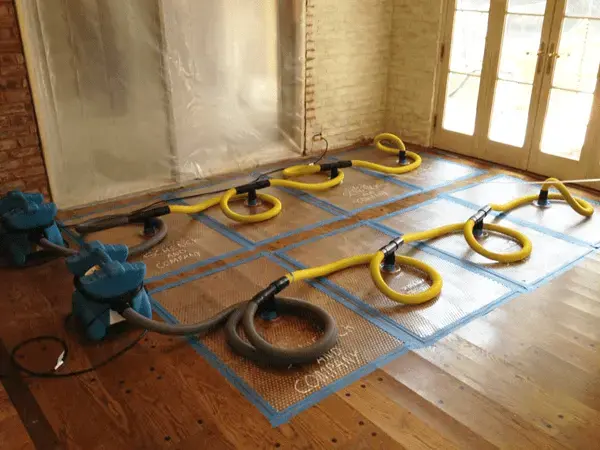
First steps for structural drying and dehumidification in Kernersville
- 01
Stop the water
Make sure the source is off before drying can start.
- 02
Close windows in humid weather
Outdoor air in a Kernersville summer adds moisture to a wet room.
- 03
Skip the box fans
Fans alone push moisture around and can spread contamination.
- 04
Call for a drying plan
Moisture mapping and sized equipment finish the job faster and verify it.
How structural drying and dehumidification is handled in Kernersville
Structural drying is the part of a water loss that decides whether a house comes back sound. Surface drying makes a floor look fine in a day; structural drying pulls water out of framing, subfloor, drywall and hardwood until each reads within 2 to 4 points of a dry reference material in the same building.
What does structural drying and dehumidification cost in Kernersville, NC?
Structural drying in Kernersville typically runs $1,200 to $3,500 for one or two rooms and $3,500 to $8,000 when the drying covers a whole floor plus the crawl space below.
One or two rooms
- Class 1 or 2 loss
- Air movers and one dehumidifier
- Three to five days
Floor plus crawl space
- Drying above and below the floor
- Several dehumidifiers
- Cavity drying
Whole level or hardwood
- Class 3 or 4 materials
- Desiccant dehumidification
- Floor mat systems
Ranges are typical, not a quote: the water category, square footage, material class and how fast drying started move the number most. Run the Kernersville water damage cost calculator for a closer range.
The structural drying and dehumidification process, start to dry
The tech who does the walkthrough maps moisture before any equipment goes down, so the drying plan matches what is actually wet.
- 1
Map
Meters and thermal imaging set the wet boundaries and the class of loss.
- 2
Set
Air movers, dehumidifiers and cavity or floor systems go in.
- 3
Monitor
Readings are logged every day and equipment is adjusted.
- 4
Release
Equipment comes out when materials meet the dry goal.
Why drying in the Piedmont takes a plan
Kernersville summers are humid, so open windows and box fans often add moisture instead of removing it. Many homes also sit over vented crawl spaces that pull damp air under the floor. A closed drying chamber with dehumidifiers controls that air.
- Humid outdoor air for much of the year
- Crawl spaces under most floors
- Hardwood, cabinets and subfloor that hold water
- Older plaster and block in houses near downtown
Equipment sized to the class of loss
Class 1 to 4 describes how much water the materials absorbed, and it sets how many air movers and how much dehumidification a room needs. LGR dehumidifiers handle most losses; desiccant units dry dense Class 4 materials and cool crawl spaces.
Wall cavities get injection drying through small holes, and hardwood gets floor mats under negative pressure.
Readings decide when it is done
The drying team records temperature, humidity and material readings every day, and equipment comes out only at the dry goal. EPA indoor air quality guidance explains why damp materials affect the air indoors, and NC State Extension covers moisture and humidity in Southeastern homes.
- Moisture map at the first visit
- Daily psychrometric and material readings
- Equipment adjusted as the job dries
Trade fact: a dry reference is an unaffected piece of the same material in the same house, which is why the goal is measured, not guessed.
Structural drying and dehumidification across Kernersville and Forsyth County
The Kernersville restoration crew covers ZIP 27284 and 27285, from the older houses around downtown and Main Street to the Union Cross, Piney Grove and Macy Grove subdivisions.
Nearby coverage reaches Walkertown, Colfax, Wallburg, Oak Ridge, Stokesdale.
Related water damage services in Kernersville
Structural Drying and Dehumidification questions in Kernersville, NC
What does 'dry' mean in restoration?
Materials read within 2 to 4 points of a dry reference material in the same building, recorded on a meter, not judged by touch.
Why are there so many machines?
The class of loss sets the evaporation load. Air movers and dehumidifiers are sized to it so the job dries in days, not weeks.
Can I turn the equipment off at night?
Equipment should run continuously. Turning it off lets humidity climb and slows drying.
Why is it so warm in the house during drying?
Warm air holds more moisture and speeds evaporation, and dehumidifiers give off heat as they work.
How long does structural drying take?
Most losses dry in three to five days. Hardwood, crawl space framing and dense materials take longer.
Does drying prevent mold?
Drying wet materials within 24 to 48 hours is the best way to keep mold from starting.
Wet framing in Kernersville? Dry it to a measured goal.
Moisture mapping, sized equipment and daily logs until every material reads dry, 24/7.
(888) 578-4720Kernersville drying team, 24/7