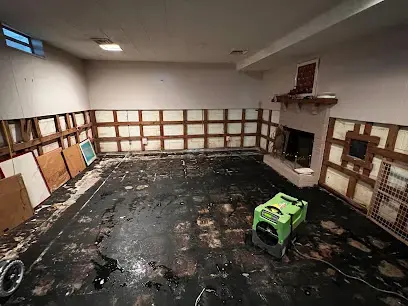
Many Kernersville subdivisions from the 1980s to the 2000s were built on sloped lots, and some of those houses have walkout or partial basements. When a thunderstorm sends runoff downhill, the lowest door and the slab are the first places it reaches.
Key takeaways
- Storm runoff in a basement is treated differently from a plumbing leak, because it carries soil and debris.
- A walkout basement is often wet at the door, the slab joint or the window wells first.
- Do not walk into standing water near outlets, a panel or a furnace until the power is off.
- The work is pump out, removal of wet porous material, and drying down to the slab.
- Preventing the next event means moving water away from the house, not only drying the room.
Why sloped Kernersville lots take on runoff
The subdivisions of Union Cross, Piney Grove and Macy Grove were built from the 1980s to the 2000s, and many lots lean toward the street or toward a drainage path. A walkout basement sits on the low side of that lean.
Kernersville also sits near the Abbotts Creek headwaters, and humid Piedmont summers bring heavy thunderstorms and the remnants of tropical storms. In that setting, basement flooding in Kernersville often starts at ground level, not from a pipe.
A walkout basement is a living space with an outside door, so the threshold, the weatherstripping and the patio drainage all matter. A small gap that never mattered during light rain can let water in during a downpour.
- Water running down a slope toward a walkout door can pool at the threshold.
- Window wells fill during a downpour and can leak at the glass.
- Water can seep through the joint where the slab meets the wall.
- Overflowing gutters and downspouts add water right at the foundation.
Runoff or a plumbing leak: why it matters
A supply pipe leak starts as clean water. Storm runoff does not, because it crosses lawns and driveways before it reaches the house.
That difference changes what the crew removes and how the space is cleaned.
The category of water decides the plan. A leak from a supply pipe, a sump pump failure and storm runoff may all end up on the same floor, but each needs a different level of cleaning.
- Clean supply water can often be dried in place if it is caught early.
- Storm water is handled as contaminated, with porous materials such as carpet and pad removed.
- Silt on the floor is removed before drying, so it does not dry into the slab.
- Antimicrobial cleaning is part of the work when storm water entered.
- A leak that started in a wall or ceiling needs the main valve shut off, while runoff needs the outside source dealt with.
What to do first
Safety again comes first. A basement with standing water often has outlets, a furnace and a panel at floor level.
If you cannot reach the panel dry, do not enter the room, and call for help.
The first few decisions are small ones, and they set up the rest of the job. Safe power, a clear path to the water and a record of what happened are enough to start.
Before anyone goes downstairs
Turn off power to the basement at the panel only if the panel is dry and reachable.
Keep children and pets out of the water, and wear boots and gloves if you must enter.
What can wait
Photographs of the water mark on walls and furniture help with repairs, and they can be taken from the stairs.
Moving furniture can wait until the water is pumped out, unless an item is heavy and in danger of tipping.
Check the water source
If the water is coming in at a door or window, the cause is outside. If it is coming from a wall or a ceiling, shut off the main water valve in case a pipe has failed.
Note which one it is when you call, because it changes what the crew brings.
Pump out and dry down to the slab
The crew starts with a pump out, then removes wet material and silt. The goal is to reach a bare slab that can dry.
A storm and flash flood cleanup in Kernersville job includes cleaning and antimicrobial treatment before the drying equipment is set.
Silt is worth a mention. Storm water leaves a thin layer of soil on the slab, and if it dries in place it can hold odor and moisture, so the crew shovels or vacuums it up before drying starts.
- Pump out standing water in stages so walls and slab are not stressed.
- Remove carpet, pad and wet drywall to above the water mark.
- Clean and treat surfaces that touched storm water.
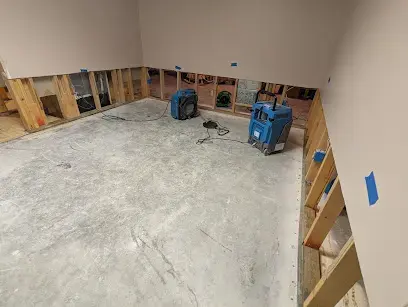
- Set dehumidifiers and air movers and log moisture readings.
Finished and unfinished basements
An unfinished basement with a concrete floor and block walls has few materials to remove, and the work is mostly pumping and drying.
A finished basement is more involved, because carpet, pad, drywall and framing can hold water.
Furniture, rugs and stored boxes are the usual losses in either kind of basement. Wet cardboard and fabric that touched storm water are generally discarded, while hard goods can often be washed and dried.
- Unfinished: concrete floor and block walls, pump out and dehumidification.
- Finished: flood cuts in drywall, removal of carpet and pad, and drying of framing and slab.
- Storm water in either: contamination controls and HEPA air scrubbing in the work area.
Drying and preventing a repeat
After the cleanup, structural drying in Kernersville brings the slab, walls and framing to a dry reading before rebuilding.
If water also reached a garage slab or a crawl space on the same lot, the water extraction team in Kernersville can pull that standing water in the same visit.
Fixes outside the house that keep water out
Drying the room does nothing if the next storm sends the same water back. After the cleanup, walk the lot with a plan to move water around the house instead of toward it.
A contractor or landscaper can help with grading, and the homeowner can handle several of the small steps below.
- Extend downspouts so water lands well away from the foundation.
- Clear gutters and window wells before storm season.
- Seal gaps around the walkout door and basement windows.
- Rebuild the soil slope so it falls away from the walls.
- Test a sump pump, if there is one, and make sure its discharge does not return to the house.
Questions
Is a walkout basement more likely to flood in Kernersville?
It depends on the lot. A walkout door sits on the low side of a sloped lot, so runoff can reach it first. Grading and downspouts make a large difference.
Do I need to remove carpet in a basement that flooded with storm water?
Usually yes. Carpet and pad that took in storm water are treated as contaminated and are removed rather than dried in place.
Can I use a wet vacuum on a flooded basement floor?
For a small amount of water, yes, with an outlet that is dry and a cord that is not in the water. Standing water in quantity needs a pump.
What is the difference between pumping out and drying?
Pump out removes standing water. Drying removes the moisture left in the slab, walls and framing, and it is confirmed with readings.
Will a sump pump stop this?
A working sump pump can help with groundwater, but runoff entering at a door or a window well also needs outside fixes.
How do I know the basement is dry enough to rebuild?
Moisture readings in the slab, the wall bottoms and the framing show it. A floor that feels dry to the touch can still hold moisture.