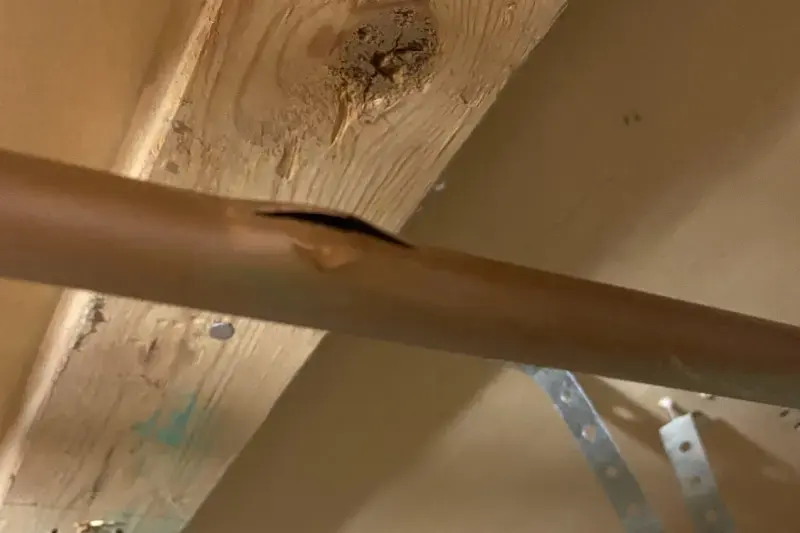
A split supply pipe sends water through a house faster than most owners expect. In some Kernersville homes built from the 1980s to the mid 1990s, the pipe behind the wall may be polybutylene, a gray plastic supply pipe that can fail at its fittings without much warning.
Key takeaways
- Shut off the main valve first, then open one low faucet to drain the pipes.
- Some Kernersville homes from the 1980s to the mid 1990s carry polybutylene supply pipe, so a split fitting is a real possibility in that era of housing.
- Water from a split pipe runs into slab garages, wall cavities and crawl space floors, so the damage is often wider than the wet spot you can see.
- Extraction and wet material removal come before any repair work, and drying is confirmed with moisture readings.
- Photos taken before anything is moved make the repair and the insurance conversation easier.
Why polybutylene comes up in Kernersville houses
Kernersville has a mixed housing stock. Early and mid century houses sit on brick piers and crawl spaces around downtown, while the 1980s to 2000s subdivisions of Union Cross, Piney Grove and Macy Grove add crawl spaces, slab garages and walkout basements on sloped lots.
Within that mix, some homes from the 1980s to the mid 1990s were plumbed with polybutylene supply pipe. When one of those pipes or fittings gives way, the result is a burst pipe in a Kernersville home that can run for a long time before anyone sees it.
Because the pipe often runs inside walls and above ceilings, the first sign is frequently a stain, a soft spot or the sound of water, not a visible spray.
- Gray or blue plastic supply pipe near the water heater or where the water enters the house is a common sign.
- Stains on a ceiling below a bathroom or on a garage wall can point to a slow fitting leak.
- A sudden drop in water pressure sometimes comes before a full split.
- A plumber can confirm the pipe material and tell you whether a repipe makes sense.
The first steps, in order
The goal at the start is to stop the water and keep people safe. Everything else waits until the supply is off.
Work through the steps below, and stop if water is near electrical outlets or a panel.
- Shut off the main water valve, usually near the meter or where the supply enters the house.
- Open one faucet at the lowest point of the house to drain what is left in the pipes.
- Switch off the water heater if the leak is near it, because a tank with no incoming water can be damaged.
- Turn off power to wet rooms at the breaker panel only if the panel is dry and you can reach it safely.
- Move rugs, papers and small furniture out of the water, and lift sofa legs onto foil or plastic.
- Take photos and short video of the pipe, the wet areas and anything damaged.
- Call a restoration crew before pulling up carpet or cutting drywall, so wet material is documented first.
Where the water goes after a split
Water follows gravity and the easiest path, and in Kernersville houses that path depends on how the house is built.
That is why a small wet patch on a ceiling or baseboard can hide a much larger wet area behind it.
Slab garages and utility rooms
On a slab, water spreads outward until it meets a wall, then climbs into the bottom of the drywall and the bottom plates of the framing.
Garage storage, cardboard boxes and stored fabric soak it up quickly, so these items should be lifted first.
Crawl space floors
In a crawl space house, water that soaks through a bathroom or kitchen floor can drip into the space below and wet the insulation and joists.
Wet insulation holds water against the underside of the floor, so a hardwood or vinyl floor above can begin to cup or lift.
Wall cavities
A split inside a wall fills the cavity from the bottom up. The drywall can look fine on the surface while the paper facing and the framing stay wet.
Moisture readings, not the look of the wall, show how far the water traveled.
What the crew extracts and removes first
A pipe burst begins with clean supply water, which is the easiest kind to dry in place if it is caught early. The longer it sits, the more material has to come out.
The crew starts with extraction, then decides what can stay and what cannot. The water extraction work in Kernersville covers standing water on hard floors and in carpet before it wicks upward.
- Standing water is pulled with extraction equipment from floors and carpet.
- Carpet pad is lifted and usually discarded, and carpet is lifted or floated to dry.
- Baseboards are pulled so the bottom of the wall can breathe and dry.
- Wet insulation in crawl spaces and wall cavities is removed so it does not hold water against framing.
- Small flood cuts open wet drywall when the cavity behind it will not dry on its own.
Drying, repair and the order of work
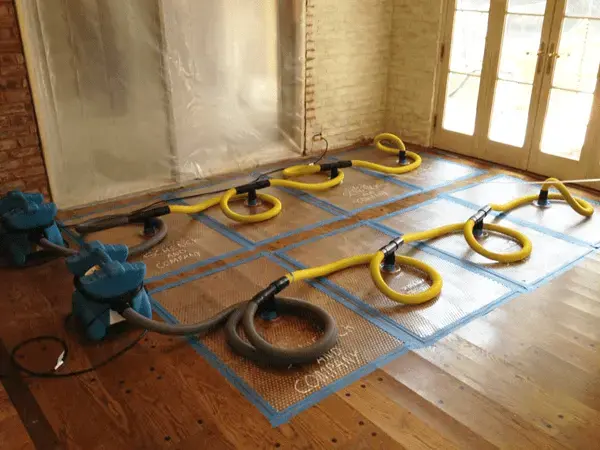
After extraction, air movers and dehumidifiers run while moisture readings are logged each visit. Drying is finished when the framing and subfloor read dry, not when the surface feels dry.
The structural drying in Kernersville page explains the equipment, and the sequence matters because repairs on top of wet material cause trouble later.
The plumber repairs or replaces the failed pipe, and the restoration crew dries the structure. These two jobs can overlap, as long as the water stays off while drying equipment runs.
- Stop the water, then extract.
- Remove material that cannot dry, then set drying equipment.
- Confirm dry readings, then rebuild.
- Replace the failed pipe or fitting, and ask the plumber whether other polybutylene runs in the house are worth changing.
Records that help afterward
Photos of the split pipe, the wet floor and the damaged contents help with repair estimates and with any conversation with an insurance company.
Keep the plumber's note about the failed pipe, the drying readings and a short list of what was removed. These are plain documents that save time later.
A homeowner who keeps the failed section of pipe, if the plumber allows it, also gives everyone a clear view of what actually failed.
Repair, repipe or both
Fixing the one failed spot is quick, but a house with polybutylene may have more of the same pipe behind other walls. That is a decision for the homeowner and a plumber, not for the restoration crew.
What the crew can do is leave the work areas open long enough for the plumber to see the pipe and fittings. It is much easier to inspect a run of supply pipe before drywall goes back up than after.
- Ask the plumber to check fittings near the water heater and at the manifold or main.
- Ask whether other bathrooms, the laundry and the kitchen share the same pipe type.
- Schedule repairs after the moisture readings confirm the framing is dry.
Questions
How can I tell if my Kernersville house has polybutylene pipe?
Look at the supply pipe near the water heater, under sinks and where the water enters the house. Gray or blue plastic pipe is a common sign, and a plumber can confirm it.
Which valve do I shut off first?
The main water valve for the house, usually near the meter or where the supply enters. Then open one low faucet to drain the pipes.
Is water from a split supply pipe safe to handle?
It starts as clean water, but it collects dirt and bacteria as it sits in carpet and insulation. Avoid standing in it near electrical outlets, and let the crew remove wet porous material.
Will the floor above a wet crawl space be ruined?
Not always. If wet insulation is pulled and the joists and subfloor are dried quickly, many floors recover without being replaced.
Does a burst pipe in a slab garage need drying too?
Yes. Water climbs into the bottom of walls and soaks stored items, so the bottom of the wall and the floor edges are dried and checked with moisture readings.