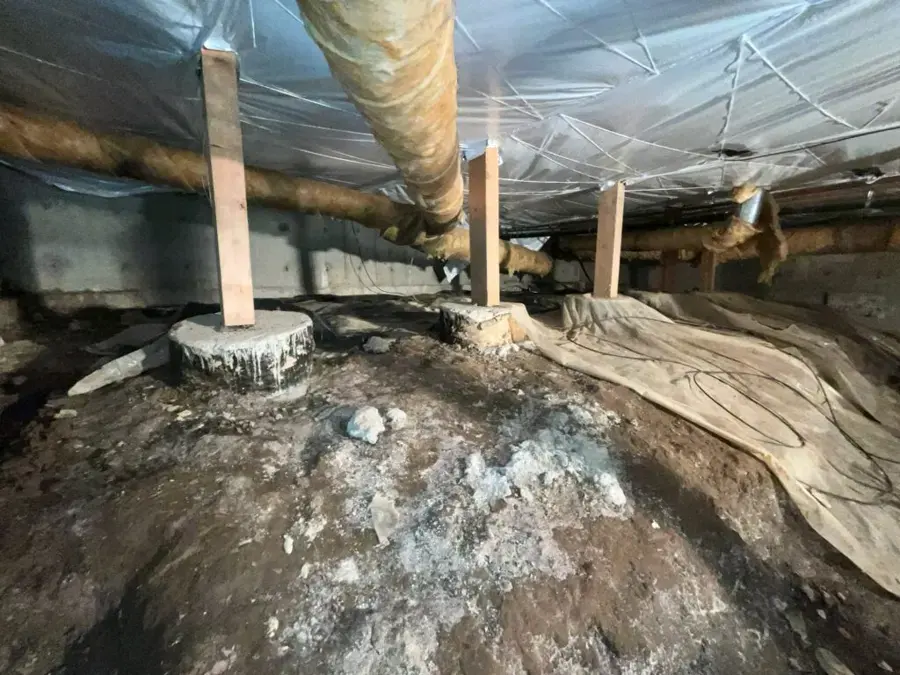
Humid Piedmont summers bring heavy thunderstorms and, now and then, the remains of tropical storms. In a Kernersville house with a crawl space, that rain can end up under the floor where nobody looks until the floor above starts to feel wrong.
Key takeaways
- Standing water, wet soil and damp air under a house are three different problems, and each is handled differently.
- Wet insulation holds water against the underside of the floor, which is how cupping and soft spots start.
- Do not enter a flooded crawl space with wiring, ducts or a furnace in it until the power is off.
- Extraction, removal of wet insulation and drying of the joists and subfloor come before any repair.
- Fixing where the water enters, such as gutters and grading, matters as much as drying.
Why Kernersville crawl spaces take on water
Around downtown Kernersville, early and mid century houses sit on brick piers over crawl spaces. The 1980s to 2000s subdivisions of Union Cross, Piney Grove and Macy Grove also have crawl spaces, and many of those lots slope.
When a thunderstorm drops heavy rain, runoff follows the slope and the foundation. A crawl space water damage call in Kernersville often starts with a soft spot in the floor days after the storm, not during it.
Summer is the usual season for this problem. Humid air keeps the soil damp, and a strong storm on top of that can push a crawl space past what the soil and the vents can handle.
- Downspouts that dump next to the foundation send water straight toward the vents.
- Soil that slopes toward the house carries runoff under it.
- Vents and access doors at ground level can let in surface water during a downpour.
- A plumbing leak can look like a rain problem, so check whether water is still running.
- Wet seasons leave the soil under the house damp for days, so the next storm adds to water already there.
- Older brick pier houses near downtown often have open vents at ground level.
How to tell standing water from damp air
Looking into a crawl space with a flashlight is the quickest check, as long as the opening is dry and the power is off.
The signs below separate the three conditions.
- Standing water shows a reflective surface, sometimes with floating debris, and soil that is soft or muddy.
- Wet soil is dark and damp to the touch, but there is no pool on the surface.
- Damp air shows as condensation on pipes and ducts, a musty smell, and insulation that feels moist but not soaked.
- Sagging insulation, a loose vapor barrier or stains on joists mean the space has been wet for some time.
What to do before a crew is on site
Safety comes first, because a crawl space often holds wiring, a furnace or duct work.
If the opening is wet and the equipment is low to the ground, turn off power to that part of the house at the panel.
Stay out of the water
Standing water in a crawl space can carry soil, debris and contamination from runoff, so avoid wading in without protection.
Do not run a household vacuum or a pump on an extension cord through wet ground.
Protect the floor above
Move rugs and furniture off any area of floor that feels soft or looks cupped.
Open interior doors to improve airflow, and photograph the floor so changes are easy to track.
Look at the outside first
Walk the outside of the house and look at where the downspouts end and where the soil slopes. A pooled spot near the foundation often matches the wet area underneath.
Take photos of those spots too, because they show the cause as well as the result.
What the crew does under the house
The first job is to pump out the water. After that, the crew pulls wet insulation down from the joists, because insulation left in place keeps water against the floor.
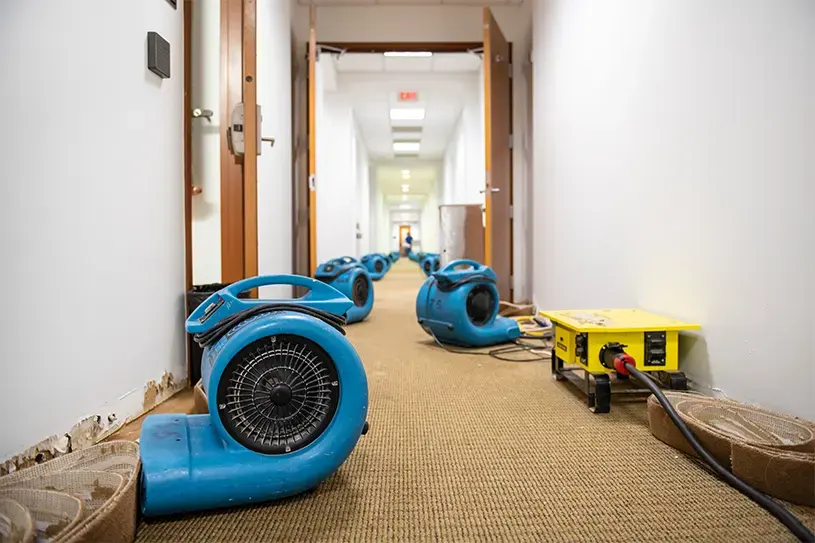
The water extraction crews in Kernersville use pumps that work from low spots in the space, then set dehumidifiers and air movers to dry the framing.
When the water was only runoff from a clean rain, the space can usually be cleaned and dried without much more. When it carried sewage or dirty storm water, the soil surface and the framing need antimicrobial treatment before drying starts.
- Pump out standing water from the lowest point of the space.
- Remove wet insulation and loose vapor barrier.
- Check joists and subfloor with moisture readings.
- Dry the space with dehumidifiers and air movers until the framing reads dry.
Drying the floor above
A wet crawl space can lift hardwood and swell subfloor from below, which is why drying works on both sides of the floor at once.
The structural drying process in Kernersville uses daily readings to decide when the floor system is dry, and then decides whether a floor can stay.
A floor that was wet for only a short time often recovers. A floor that stayed wet for weeks may need replacing in the worst boards, and only readings and an inspection can tell the two cases apart.
- Cupping can begin when the moisture level in the subfloor stays high.
- Floor mat systems or air movers pull moisture out of the floor from above.
- A dehumidifier under the house lowers humidity in the space and keeps the joists drying.
- A floor that is covered with rugs or heavy furniture dries more slowly, so move them off while the crew works.
Stopping it from happening again
After the space is dry, the cause matters. If runoff is entering, the fix is outside the house.
Extend the downspouts, regrade where the soil leans toward the foundation, and check that vents and doors do not sit where water pools.
If the space also gets water from a basement area nearby, the basement flooding cleanup in Kernersville page covers the same pump out and drying approach for lower levels.
Signs the floor above has already been affected
Many owners find out about crawl space water from the floor, not from the crawl space. The floor often changes a little at a time, so it helps to know what to watch for.
If you notice any of these after a storm, a look under the house is worth doing.
- Hardwood boards that curve upward at the edges, a pattern called cupping.
- Soft or springy spots near a bathroom, a kitchen or an outside wall.
- A musty smell that is stronger near floor vents.
- Doors that begin to stick because the floor has moved.
- A cold, clammy feel on the floor in the morning.
Questions
Is water in a crawl space always a flood?
No. It can come from runoff, a plumbing leak or high groundwater. Looking at where the water pools, and whether a pipe is dripping, shows which one it is.
How soon does wet insulation need to come out?
As soon as it is wet. Insulation holds water against the floor above, so pulling it early protects the joists and subfloor.
Can I run a fan under the house myself?
Only if the power is dry and safe. For most standing water, extraction first is better than moving air over a wet space.
Will my hardwood floor cup after crawl space water?
It can. Cupping is more likely when the subfloor stays wet. Drying from below and above lowers the risk.
Does a Kernersville thunderstorm mean the crawl space will flood?
Not every storm. The slope of the lot, the downspouts and the grading around the house decide how much water reaches the space.
What does a restoration crew check in a Kernersville crawl space?
The crew looks for standing water, wet insulation, wet joists and subfloor, and a loose or torn vapor barrier. Moisture readings show how far the water reached.